
The Kids Are Watching Us: How Booster Drama and Adult Conflict Shape the Real Lessons in Fine Arts Programs
- soundstageedu
- May 15
- 4 min read

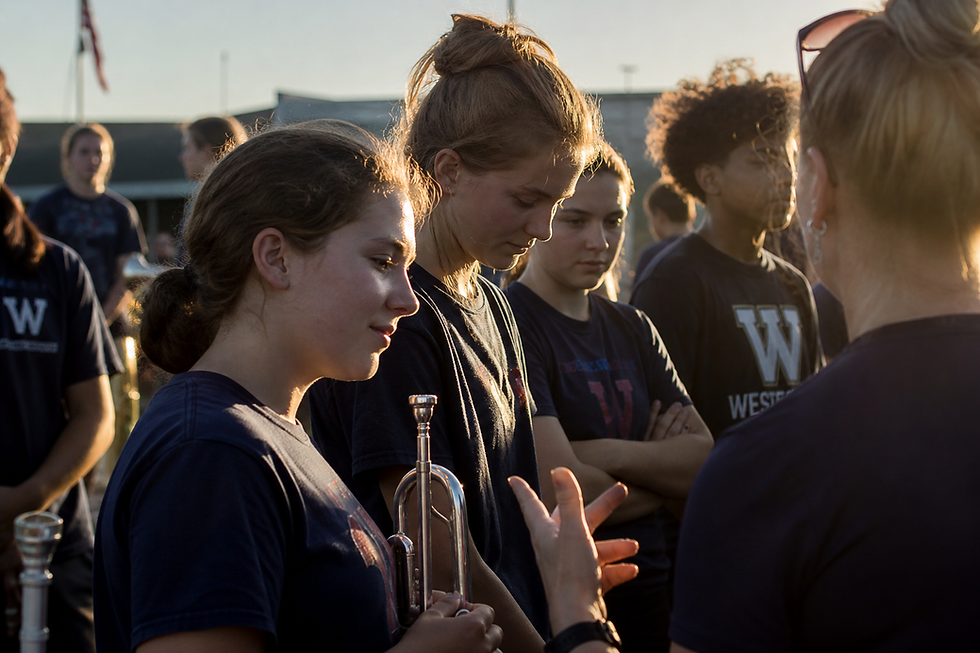
Right now, sitting in or coming into your programs is a generation of students who will be sitting in our rehearsal halls watching the adults around them more closely than we realize. They are watching how we disagree. They are watching how we speak to one another when tensions rise. They are watching what happens when we do not get our way. They are watching whether the people who claim to support them are actually protecting the culture around them or quietly tearing it apart from the inside.
And the heartbreaking part is this: many of these students will remember the behavior of the adults longer than they remember the scores, the trophies, or even the performances.
That should stop every one of us in our tracks.
Across the country right now, there is so much noise surrounding fine arts programs. Board fights. Community arguments. Parent feuds. Political battles. Social media pile-ons. Meetings filled with frustration and suspicion. Entire communities splitting themselves apart over music selections, leadership decisions, budgets, bylaws, uniforms, travel, fundraising, and personalities. Sometimes the issues are serious and deserve thoughtful discussion. Sometimes they absolutely require accountability and hard conversations. But somewhere along the way, many adults forget who is standing in the middle of all of it.
The kids.
The kids who just wanted to play music.
The kids who showed up looking for belonging.
The kids who found confidence in a rehearsal room before they ever found it anywhere else.
The kids who are learning leadership, discipline, teamwork, resilience, emotional regulation, time management, empathy, accountability, and sacrifice in these programs every single day.
These programs are not just extracurricular activities. They are life learning laboratories. Every rehearsal, every performance, every difficult moment, every recovery after failure is shaping who these students become as human beings. The lessons are everywhere. The students absorb all of it. Not just from directors. Not just from staff... But from us.
Especially from us.
Adults love to say that students need stronger character, better leadership skills, more resilience, more respect, more emotional maturity. Then some of those same adults walk into meetings and model the exact opposite. Public humiliation. Gossip. Power struggles. Passive aggression. Tribalism. Personal attacks disguised as “concern.” Social media warfare dressed up as advocacy. Students see it. They hear it in the hallways. They read the comments. They watch the tension unfold in parking lots, booster meetings, Facebook groups, and school board sessions.
And whether we intend it or not, we are teaching them.
We are teaching them how adults handle conflict.
We are teaching them how communities respond to disagreement.
We are teaching them whether power matters more than people.
We are teaching them whether empathy survives when emotions run high.
We are teaching them whether music and arts education are truly about human growth or whether they are simply another arena where adults fight to feel important.
The loudest curriculum in any arts program is not written on paper. It is written in behavior.
Students can survive a difficult season. They can survive a tough loss. They can survive imperfect leadership. What damages them deeply is when the adults responsible for protecting the environment become the source of instability themselves. When the adults create an atmosphere where fear, bitterness, politics, or ego dominate the room, students stop feeling safe. And once safety disappears, learning starts disappearing with it.
That is why this moment matters so much.
Not just in Watertown. Everywhere.
Every parent group. Every booster organization. Every school board. Every leadership team. Every comment section. Every rehearsal hall.
Because the students sitting quietly in those chairs today are becoming tomorrow’s teachers, parents, leaders, volunteers, artists, and community members. They are building their understanding of adulthood by watching us right now.
So, what are we showing them?
Are we showing them how to stand firm without cruelty?
Are we showing them how to disagree without dehumanizing?
Are we showing them how to protect both values and people at the same time?
Are we showing them how to prioritize mission over ego?
Or are we showing them that adults eventually let power struggles consume everything good?
The arts have always been about more than performance. The arts teach humanity. They teach emotional intelligence. They teach collaboration between people who think differently. They teach students how to listen, adapt, support, recover, and persevere. But those lessons only survive when the adults surrounding the program choose to embody them too.
The students deserve better than being trapped in the middle of adult warfare.
They deserve adults who can pause long enough to remember why these organizations exist in the first place.
Not for our pride.
Not for our politics.
Not for our personal validation.
But for them.
For the kid carrying anxiety into rehearsal and finding peace for the first time all day.
For the shy freshman who finally found belonging in the trumpet section.
For the percussionist who learned discipline through hours of repetition.
For the theater student who discovered confidence under stage lights.
For the senior who may never fully realize until years later that this program helped save them.
The students are watching us. Every moment. Every comment. Every meeting. Every reaction.
And whether we realize it or not, we are teaching a masterclass on adulthood every single day.
The question is whether the lesson is one worth learning.

Comments